 Sidney Alfred Parsons and his Ancestors
The Diaper Families of Itchen Ferry
The Diaper families of Itchen Ferry, near Southampton, are connected to the families of Sidney Parsons and his wife Dorothy Bennett two ways.
The first connection is through Mary Diaper (born 1791) whose grandaughter Harriett Boyes was Sidney Parsons’ mother. Mary’s parents were Thomas Diaper, an innkeeper from Hamble in Hampshire and his wife Catherine. Hamble (full name Hamble-le-Rice) is about five miles down Southampton Water from the old village of Itchen Ferry.
The second connection is through Hannah Diaper who married Henry Misselbrook Bennett in 1859. Henry, an agricultural labourer from Chilworth in Hampshire, was an uncle of George Henry Bennett who was Dorothy Bennett’s father. Hannah’s father Edward Diaper was a fisherman and yachtmaster from the village of Itchen Ferry.
.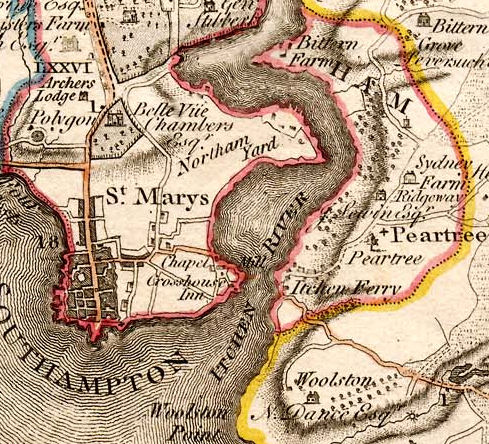
Itchen Ferry, shown in this map from 1791, was a waterside village situated near the mouth of the River Itchen. The name arose because it was
the landing place for ferries which carried travellers over the river to Southampton on one of the main routes between Portsmouth and Southampton.
Villagers were traditionally entitled to free passage on the ferries.
Early in the 19th century there was a proposal to erect a bridge but after protests by villagers and the Royal Navy, who were concerned that navigation would be obstructed, it was decided to use a floating-bridge instead. The wooden floating-bridge began service in November 1836 and the villagers lost their right to free passage.
There was originally no parish church in Itchen Ferry and the village formed part of the parish of St. Mary’s in Southampton. However in the early 17th century a church was built nearby at Peartree which acted as a chapel-of-ease to St. Mary’s. It was the first Anglican church to be consecrated after the reformation.
Life in Itchen Ferry was intimately connected to the sea and boats. Many of the men who lived there made their living as boatmen, fishermen, mariners, or shipwrights. This tradition continued until the village was lost to enemy bombing during WWII.
John Duthy, in his book Sketches of Hampshire, from 1839, wrote — “The inhabitants of Itchen are quite peculiar in their manner. Any settlers in their district who are not actual natives of the village, they consider as foreigners. The men are mostly employed in their fishing smacks; whilst the women carry to the market at Southampton the produce of their husband’s labour. Many of the baskets which they use for the purpose are of a remarkably picturesque pattern and fabric. During the summer season the vessels of the Royal Yacht Squadron engage a considerable number of the picked men of the village, who maintain a deservedly high character in that popular branch of naval service”.
Jane Austen visited Itchen Ferry several times. In a letter dated 1808 she wrote — “We had a little water party yesterday; I and my two nephews went from the Itchen Ferry up to Northam, where we landed, looked into the 74, and walked home, and it was so much enjoyed that I had intended to take them to Netley today....if we cannot get so far, however, we may perhaps go round from the ferry to the quay. I had not proposed doing more than cross the Itchen yesterday, but it proved so pleasent, and so much to the satisfaction of all, that when we reached the middle of the stream we agreed to be rowed up the river; both boys rowed great part of the way.”
Although Itchen Ferry was a notoriously insular community, by the latter part of the Napoleonic wars there were substantial numbers of Diapers living around Portsmouth Harbour about fifteen miles to the south east. Thomas Diaper - the present author’s ancestor - was among them, but he later moved to Hamble which is much closer to his ancestral home being only about five miles south-east of Itchen Ferry. During the wars there had been a large increase in the strength of the Royal Navy. On the west shore of the harbour the Royal Clarence Yard was established in 1783 on the site of an old brewery, and grew rapidly to become the Royal Navy’s main victualling depot. Nearby stood the Royal Naval Hospital Haslar, the largest brick building in England, and on the opposite shore of the harbour, the Royal Naval Dockyard in Portsmouth had seen major expansion during the wars. There would have been many employment opportunities for people with good maritime experience so it is not surprising to find that a number of Diapers were living there by the end of the first decade of the 19th century. Two of Thomas’ daughters — Mary and Rosetta — were living in Alverstoke, near to Haslar Hospital and the Royal Clarence Yard, at that time, and got married there.
Return to Sidney Parsons’ Ancestors
You are free to make use of the information in these web pages in any way that you wish but please be aware that the author, Mike Parsons, is unable to accept respsonsibility for any errors or omissions.
Mike can be contacted at parsonspublic@gmail.com
The information in these web pages comes from a number of sources including: Hampshire County Records Office, Somerset Heritage Centre; Dorset County Records Office; Southampton City Archives; the General Register Office; several on-line newspaper archives; several on-line transcriptions of Parish Register Entries; and several on-line indexes of births, marriages and deaths. The research has also been guided at times by the published work of others, both on-line and in the form of printed books, and by information from personal correspondence with other researchers, for all of which thanks are given. However, all of the information in these web pages has been independently verified by the author from original sources, facimile copies, or, in the case of a few parish register entries, transcriptions published by on-line genealogy sites. The author is aware that some other researchers have in some cases drawn different conclusions and have published information which is at variance from that shown in these web pages.
Copyright © 2013 Mike Parsons. All rights reserved.